What native audio models change for voice agents
Most voice agents still chain speech-to-text, a text LLM and text-to-speech. Native audio models skip the text in the middle. How they work, what they fix, where the cascade still wins, how well they call tools, and what to change in a cascade today.
Most voice agents in production are three models in a row. Speech-to-text (STT) turns the caller's audio into words, a text LLM decides what to say, and text-to-speech (TTS) reads the answer out. A growing set of models does the whole job in one network, with audio going in and audio coming out. People call them native, end-to-end or speech-to-speech models.
We run our voice agents on a cascade and are building DuplexTurn, a harness that grades turn-taking, so we wanted a clear view of how the native models work and whether they are ready to replace the chain. This post is what we found.
How a native audio model works
Most of these models start from a pretrained text LLM and teach it a second language made of sound.
Audio in. A neural audio codec such as Mimi, SNAC or EnCodec compresses speech into a stream of discrete tokens, with a few codebooks per audio frame. Some models skip discrete tokens on the input side and use a continuous streaming encoder with an adapter instead.
Training. The LLM is trained with ordinary next-token prediction over a mix of text and audio tokens. SpeechGPT showed this early: it used HuBERT to turn speech into discrete units and learned them alongside text, as if they were another language [1].
Audio out. This is the hard part. Each audio frame needs several codebook tokens, and they have to come out fast enough to play in real time. Three designs are common:
- Moshi (Kyutai) predicts time-aligned text tokens just before its audio tokens, which its authors call an inner monologue. A Temporal Transformer models the sequence over time, and a small Depth Transformer fills in the codebooks within each frame [2].
- Mini-Omni emits eight tokens per forward pass, one text token and seven codec layers, so text and speech are generated together [3].
- Qwen2.5-Omni splits the work between a Thinker and a Talker. The Talker reads the Thinker's hidden states rather than its text output, so it has more to go on than the words [4].
A fourth design is still research only: it drops text guidance entirely, splitting the last transformer layers by modality while the text backbone stays frozen [5].
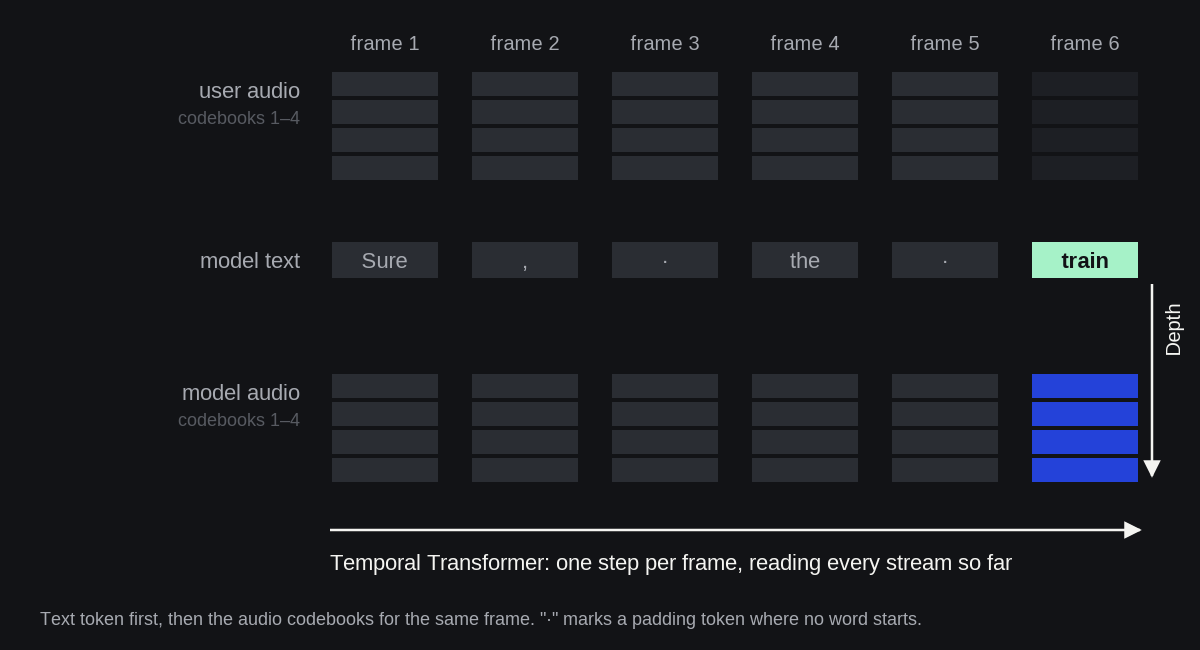
Full duplex. Some of these models are also full duplex. At every frame a model such as Moshi reads two streams: what the user is saying and what it is saying itself. It can listen while it talks, make small "mm-hm" sounds, and stop when it is interrupted.
What changes compared with a cascade
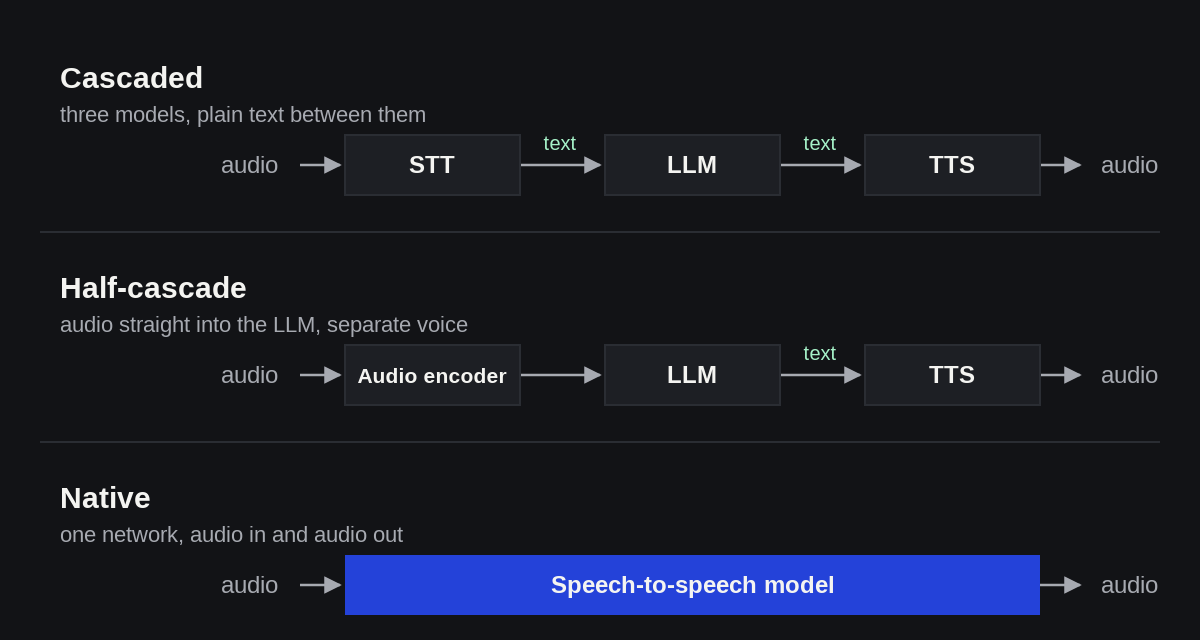
What the LLM never hears. STT keeps the words and drops how they were said: tone, sarcasm, hesitation, laughter, who is speaking. The TTS then has to guess the right delivery from plain text. A native model carries that information the whole way through.
Latency. Each stage of a cascade waits on the one before it, and an end-of-speech detector adds its own delay. A native model removes those hand-offs. Kyutai reports about 200 ms end to end for Moshi in practice, against a theoretical 160 ms [2].
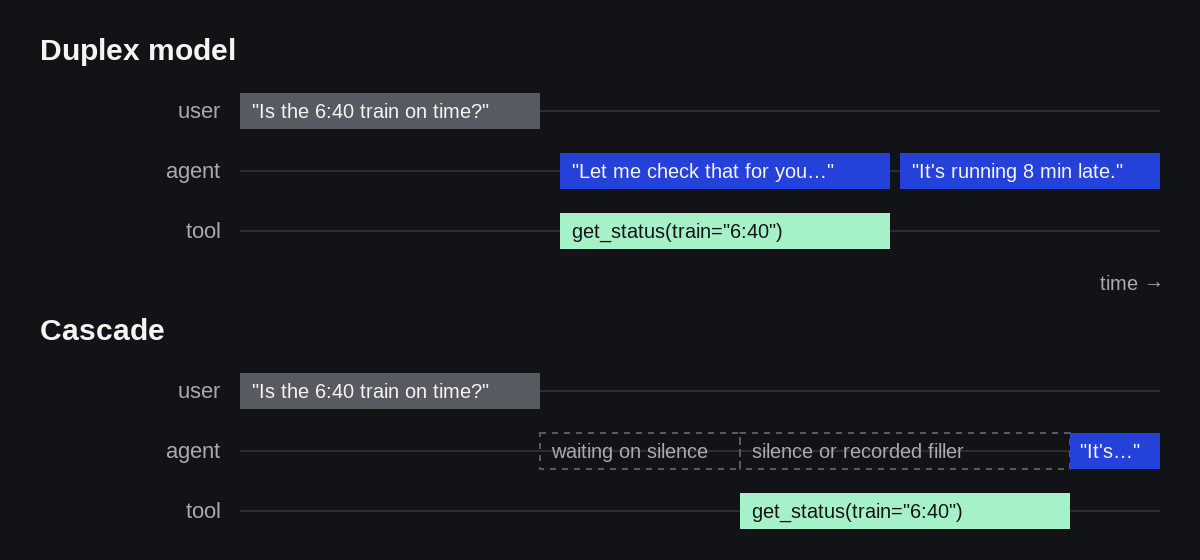
Turn-taking. A cascade usually decides that the user has finished by waiting for a fixed stretch of silence, using voice activity detection (VAD). That is why cascaded bots cut people off or leave awkward pauses. Duplex models handle overlapping speech without a rule for it.
Errors that compound. A transcription mistake goes straight into the LLM's reasoning. Accents, code-switching and noisy lines make this worse.
Where the cascade still wins
Most production deployments use a pipeline, because teams want to choose which LLM reasons, which voice the user hears and what business logic runs between the two [6]. A cascade also gives you:
- the strongest reasoning and tool calling, because any frontier LLM can sit in the middle;
- transcripts you can log, search and filter;
- parts you can swap one at a time;
- a wider choice of models built for Indian languages such as Bengali and Hindi, from Sarvam and AI4Bharat.
Native models also need a great deal of data. Matching the trillions of tokens a text LLM trains on would take hundreds of millions to billions of hours of speech [7].
Hybrids
Between the two sits the half-cascade. It feeds audio directly into an encoder, reasons with a text LLM, then synthesises speech with a separate TTS [8]. Some half-cascades, such as LLaMA-Omni and Freeze-Omni, replace the separate TTS with a speech decoder driven by the LLM's hidden states.
Some research systems run both paths at once. In RelayS2S, a fast duplex speech model drafts a short opening phrase that goes straight to TTS while the slower cascaded path catches up [9].
What exists in November 2026
The categories blur at the edges, and "open" covers everything from permissive licences to research-only weights. Check the licence before using any of these commercially.
Cascaded parts.
| Stage | Open weights | Closed or API |
|---|---|---|
| STT | Whisper, NVIDIA Parakeet and Canary, Moonshine, Kyutai STT, AI4Bharat IndicConformer | Deepgram, AssemblyAI, ElevenLabs Scribe, Google Chirp, OpenAI gpt-4o-transcribe, Sarvam Saarika |
| LLM | Llama, Qwen, Gemma, DeepSeek, Mistral | GPT, Claude, Gemini |
| TTS | Kokoro, Orpheus, Sesame CSM-1B, Chatterbox, Dia, Kyutai TTS, Indic Parler-TTS, Voxtral TTS | ElevenLabs, Cartesia Sonic, Inworld TTS, OpenAI gpt-4o-mini-tts, Sarvam Bulbul |
| Orchestration | Pipecat, LiveKit Agents | Vapi, Retell |
Two recent TTS releases stand out. Mistral's Voxtral TTS beat ElevenLabs Flash v2.5 on naturalness in Mistral's own preference tests; its weights are open but licensed CC BY-NC 4.0, so commercial use goes through Mistral's API [10]. Sarvam's Bulbul v3 covers 11 languages including Bengali, Hindi and Indian English, and Bulbul v4 Flash, released on 13 October 2026, reports under 250 ms to first audio [11].
Half-cascade. Open: Ultravox (audio in, text out, paired with any TTS), LLaMA-Omni and LLaMA-Omni 2, Freeze-Omni, Qwen2.5-Omni and Qwen3-Omni (close to native), and Voxtral and Phi-4-multimodal as audio-in, text-out models. Closed: the half-cascade variants of Gemini Live.
Native. Open: Moshi, NVIDIA PersonaPlex-7B, NVIDIA NemotronLabs VoiceChat (VoiceChat below), GLM-4-Voice, Mini-Omni, Kimi-Audio, Step-Audio 2 mini. Closed: OpenAI GPT-Live and gpt-realtime, Gemini Live native audio, Amazon Nova Sonic, Grok's voice mode, Hume EVI, and Block's Dessa as a research preview.
A few of the newer ones in more detail:
- PersonaPlex-7B, released by NVIDIA on 15 January 2026, is a 7B full-duplex speech-to-speech model built on the Moshi architecture. It is English only [12].
- VoiceChat, released on 3 August 2026, is an end-to-end full-duplex model with open weights. The repository name says 11B; NVIDIA's model card says 12B. NVIDIA calls it the first open full-duplex model that can call tools mid-conversation. It responds in about 450 ms. The weights are under the OpenMDW-1.1 licence, and NVIDIA marks the model as ready for research purposes only [13].
- GPT-Live launched on 8 July 2026 as GPT-Live-1 and GPT-Live-1 mini and now powers ChatGPT Voice. Its voice front end is full duplex. When a request needs web search, deeper reasoning or agentic work, it hands the task to a frontier model in the background, GPT-5.5 at launch [14]. GPT-Live-1 reached the API in September 2026 with telephony support, and GPT-Live-1.1 followed on 15 October with new voices and better accents [21].
- Gemini Live runs on Gemini 3.1 Flash Live and supports more than 90 languages, according to Google [22]. Gemini Live 2.5 and 3.1 in the benchmark below are earlier and current versions of the same product.
- Dessa, from Block, was trained only on recordings of human conversation, with no text and no pretrained model. It is behind a waitlist [15].
The open native models reason far worse than a text LLM. On Big Bench Audio, NVIDIA's model card puts VoiceChat at 37.0%, ahead of Freeze-Omni (33.4%), PersonaPlex (19.1%) and Moshi (4.4%) [13]. Artificial Analysis's leaderboard scores VoiceChat lower, at 27.0%, behind Freeze-Omni [23].
Tool calls
In a native model the tool call is a structured output, either special tokens or a separate channel, produced while the audio stream continues. The application runs the function and feeds the result back, usually as text, and the model works it into what it is saying. That is how it can say "let me check that" and keep talking while the request runs. A cascade can only fake this with filler audio.
The closed native models support tool calling. GPT-Live decides many times a second whether to speak, keep listening, pause, interrupt or call a tool [14]. Gemini Live, Amazon Nova Sonic and Grok's voice mode all support function calling [22, 24, 25], declared the same way as for a text LLM.
The open native models mostly do not. Moshi and PersonaPlex are built for conversation and have no tool calling. VoiceChat is the exception. It predicts tool calls on a separate output channel and keeps talking while they run. Its scores are modest: 56.1% on NVIDIA's tool-calling evaluation, falling to 27.5% on parallel multiple calls [13]. Half-cascade models such as Ultravox and the Qwen Omni models fare better, because they reason with a text LLM inside and can inherit its function calling.
How reliable it is
Full-Duplex-Bench-v3 tested this in 2026 [16]. It ran gpt-realtime, Gemini Live 2.5, Gemini Live 3.1, Grok, Ultravox v0.7 and a cascaded Whisper → GPT-4o → OpenAI TTS pipeline on multi-step tool tasks with real, disfluent human speech.
| System | Result |
|---|---|
| gpt-realtime | Best task success (Pass@1 0.600) and fewest interruptions (13.5%) |
| Gemini Live 3.1 | Fastest (4.25 s) but the lowest turn-take rate (78.0%) |
| Cascade | 100% turn-take rate, highest latency (10.12 s) |
The best system completed 60% of tasks. Self-corrections were the weakest point: gpt-realtime handled fewer than 59% of cases like "book it for Tuesday… no, Wednesday." The authors also found a trade-off between calling tools early for speed and waiting to commit for correctness.
If tool calls are central to an agent (bookings, CRM lookups, payments), a cascade is the more reliable choice. You pick the strongest function-calling LLM and can read every call as text. To get the feel of a native model without giving up reliable tools, the GPT-Live pattern can be rebuilt on a cascade: keep the text LLM as the reasoner and put a duplex or streaming voice layer in front of it.
Diffusion instead of autoregression
Every model above is autoregressive and writes one token at a time, left to right. A diffusion language model starts from masked tokens and fills them in over several denoising steps, attending in both directions. Researchers have tried this backbone at each stage of the voice stack:
| Use | Example |
|---|---|
| Audio understanding | DIFFA-2: a frozen Whisper-Large-V3 encoder, a dual adapter and a LLaDA-8B diffusion backbone [17] |
| STT | Whisper-LLaDA: a Whisper encoder feeding LLaDA-8B-Instruct as the decoder [18] |
| TTS | LLaDA-TTS: a masked diffusion model that finishes in a fixed number of parallel steps, so latency does not grow with length [19] |
| TTS | DLLM-TTS: a 0.6B model trained on 20,000 hours, competitive on Seed-TTS-eval [20] |
The appeal is speed, because many tokens are produced in parallel, and data efficiency: diffusion models have done better than autoregressive ones when training data is limited [26], which would help languages with little recorded speech. The problem is streaming. These models look at the whole output at once, which conflicts with speaking word by word. The usual workaround is block diffusion: split the sequence into blocks, denoise within each block and process the blocks in order. Tooling also lags behind autoregressive models. For now these are research results, and the first place they are likely to show up is as faster STT or TTS parts that drop into an existing cascade.
What to change in a cascade today
Much of the benefit is available without leaving the cascade. These are the changes we are making to ours, cheapest first:
- Make every stage stream.
- Replace silence-based endpointing with a semantic turn detector.
- Pass emotion and other paralinguistic tags from STT to the LLM.
- Use an expressive TTS that follows instructions about delivery.
- Later, replace STT and the LLM with an audio-input LLM, keeping the TTS.
For Bengali and other Indian languages we use Sarvam or AI4Bharat for STT, a strong LLM, and Bulbul for TTS. Coverage of the GPT-Live launch noted accent and fluency gaps in Hindi live translation [27], which OpenAI says GPT-Live-1.1 improved [21]. For open-weight full duplex we would start with PersonaPlex rather than VoiceChat, which NVIDIA marks as research-only, though PersonaPlex is English only.
What this means for DuplexTurn
Full-Duplex-Bench-v3 shows why we are building DuplexTurn: no architecture yet wins on both timing and correctness. DuplexTurn scores barge-in, backchannels, tool calls mid-turn and knowing when to stay quiet, timed against a 250 ms budget. We will run it on cascades, half-cascades and native models, and publish which wins on which task.
References
- D. Zhang et al. SpeechGPT: Empowering Large Language Models with Intrinsic Cross-Modal Conversational Abilities. Findings of EMNLP, 2023. arXiv
- A. Défossez et al. Moshi: a speech-text foundation model for real-time dialogue. Kyutai, 2024. arXiv
- Z. Xie, C. Wu. Mini-Omni: Language Models Can Hear, Talk While Thinking in Streaming. 2024. arXiv
- J. Xu et al. Qwen2.5-Omni Technical Report. 2025. arXiv
- X. Zhao et al. Towards True Speech-to-Speech Models Without Text Guidance (MOSS-Speech). ICLR, 2026. arXiv
- "Best Speech-to-Speech Model (2026)." Inworld.
- "The Future of Speech-to-Speech AI: Inside Gradium and Kyutai's Approach to Full Duplex Conversation." Coval.
- "Real-Time vs Turn-Based Voice Agents 2026." Softcery.
- L. Mai, J. Liang. RelayS2S: Dual-Path Speculative Generation for Real-Time Dialogue. Findings of EMNLP, 2026. arXiv
- "Speaking of Voxtral." Mistral AI. Licence: Hugging Face.
- "Introducing Bulbul V4 Flash text-to-speech for India." Sarvam AI. Bulbul v3: Sarvam AI.
- "NVIDIA PersonaPlex: Natural Conversational AI With Any Role and Voice." NVIDIA ADLR. Paper: arXiv.
- J. Balam et al. NemotronLabs VoiceChat: An Open Full-duplex Speech-to-Speech Model with Tool Calling Capabilities. NVIDIA, 2026. arXiv. Model card: Hugging Face.
- "Introducing GPT-Live." OpenAI.
- "Block Unveils Dessa, a Full-Duplex Speech Model Trained Only on Speech." MarkTechPost.
- G.-T. Lin, C. Chen, Z. Chen, H. Lee. Full-Duplex-Bench-v3: Benchmarking Tool Use for Full-Duplex Voice Agents Under Real-World Disfluency. 2026. arXiv
- J. Zhou et al. DIFFA-2: A Practical Diffusion Large Language Model for General Audio Understanding. Findings of ACL, 2026. arXiv
- Audio-Conditioned Diffusion LLMs for ASR and Deliberation Processing. 2025. arXiv
- X. Fan et al. LLaDA-TTS: Unifying Speech Synthesis and Zero-Shot Editing via Masked Diffusion Modeling. 2026. arXiv
- W. Madha et al. DLLM-TTS: Block Discrete Diffusion Language Model for Text-to-Speech Synthesis. 2026. arXiv
- "Getting started with GPT-Live." OpenAI Developers. GPT-Live-1.1: OpenAI Community.
- "Build with Gemini 3.1 Flash Live." Google.
- "Speech to Speech leaderboard." Artificial Analysis.
- "Tool use with Amazon Nova Sonic." AWS.
- "Grok Voice Agent API." xAI.
- M. Prabhudesai et al. Diffusion Beats Autoregressive in Data-Constrained Settings. 2025. arXiv
- "OpenAI releases new voice models for more natural live conversations." TechCrunch.