Measuring turn-taking in voice agents
A voice agent can be fast and still talk over people. What people do in conversation, the events worth timing, how to measure them from a recording rather than server logs, and the trade-off every endpointing setting makes.
Ask a team how their voice agent performs in conversation and they will usually give one number: latency. It is one of several numbers that matter. An agent can answer in 300 ms and still cut users off whenever they pause to think, keep talking when they try to interrupt, or stop dead every time they say "mm-hm".
This post covers what people do when they take turns, the events worth timing in a voice agent, how to measure them so the numbers match what a caller hears, and the trade-off that every endpointing setting (the rule that decides the user has finished) makes. It is the measurement plan behind DuplexTurn, the turn-taking harness we are building.
What people do
Turn-taking between people is fast. Stivers and colleagues timed question-and-answer turns in ten languages, including Japanese, Danish and ǂĀkhoe Haiǁom, and found the same pattern in all of them: most gaps between one speaker finishing and the next starting were short, with the most common gap between 0 and 200 ms [1]. Languages differed in their averages, from about 7 ms in Japanese to about 470 ms in Danish, but every language showed the same shape: most replies began within a few hundred milliseconds.
That speed is not possible by waiting for silence. Planning and saying even a single word takes around 600 ms [2]. So listeners predict where the turn will end from its words, grammar and intonation, plan their reply while the other person is still talking, and launch it as the turn closes [2].
Pauses inside one person's turn are often longer than the gaps between turns [3]. Someone reading out a card number, or thinking mid-sentence, can go quiet for a second or more without having finished, so a silence timer cannot tell the two apart.
The events worth timing
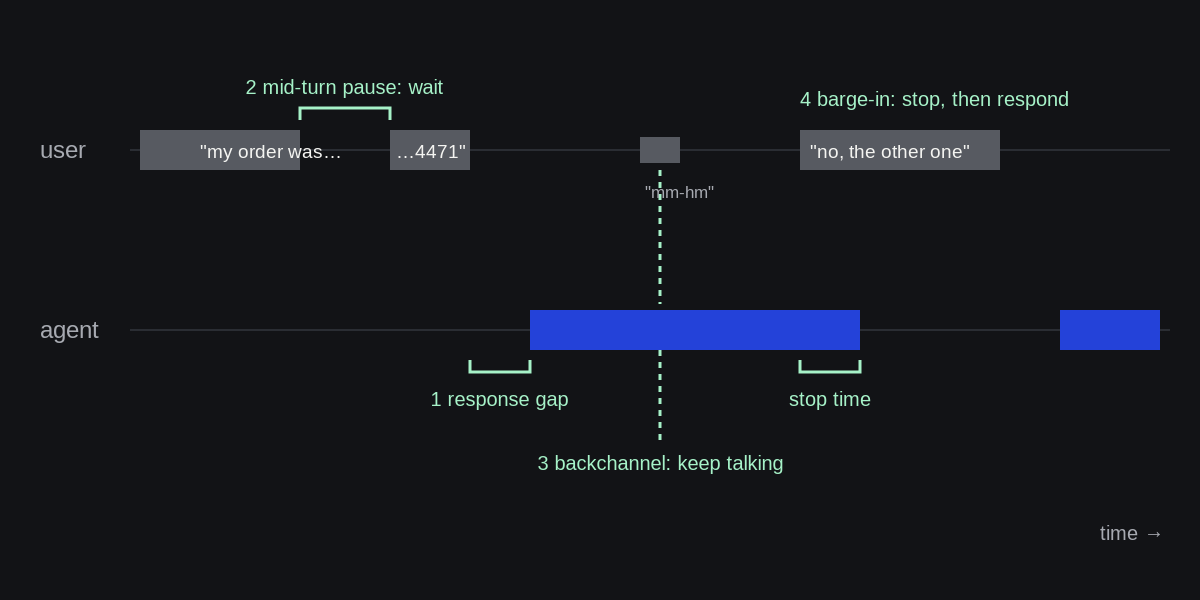
- Response gap. The time from the user's turn end to the agent's first sound. Too long and the caller wonders whether the line dropped.
- Mid-turn pause. The user pauses but has not finished. The agent should wait. If it starts speaking, that is a false takeover: the user has been cut off.
- User backchannel. While the agent is talking, the user says "mm-hm", "right" or "okay". The agent should keep going. Stopping turns every acknowledgement into an interruption.
- Barge-in. The user starts talking over the agent to correct or redirect it. The agent should stop quickly and respond to what was said.
- Agent backchannel. During a long user turn, a short "mm-hm" from the agent tells the user it is still listening. Most cascaded frameworks focus on detecting the user's backchannels rather than producing their own; full-duplex models can do both.
Noise sits under barge-in. A cough, a door, a television or a second voice in the room should not stop the agent. A test set needs these too, or an agent that stops for every sound will score well on barge-in.
The metrics
| Metric | What it measures | How it is computed |
|---|---|---|
| Response gap | Speed after a real turn end | User's turn end to agent's first audio; median and 95th percentile |
| False takeover rate | Cutting users off | Share of planted mid-turn pauses where the agent starts speaking |
| Missed turn rate | Leaving users hanging | Share of turn ends with no agent response within a set limit, such as 2 s |
| Barge-in stop time | Yielding when interrupted | User's first speech over the agent to the agent's audio stopping |
| False stop rate | Yielding when it shouldn't | Share of user backchannels and noise events where the agent stops |
| Backchannel timing | Whether agent acknowledgements land where a person's would | Agent "mm-hm" placements compared with human placements on the same recordings |
| Recovery | Responding to the interruption | Whether the agent's next turn addresses what the user said when they barged in, graded per case |
The first two pull against each other; the section on the endpointing trade-off below shows why. Recovery needs a judgement about content, so it is graded by a person, or by an LLM judge whose grades have been checked against a person's on a sample.
Full-Duplex-Bench measures a similar set [4]. Its first version scores pause handling, backchannelling, smooth turn-taking and user interruption, using a takeover rate for the first and comparing the timing of an agent's backchannels with human ones for the second. Version 1.5 adds overlapping speech, including side conversations and ambient speech [5]; version 2 adds multi-turn tasks run by an automated examiner [6]; and v3 adds tool calls made mid-conversation [7].
The endpointing trade-off
A short silence threshold gives fast responses and more false takeovers; a long one cuts users off less and makes every response slower. Because mid-turn pauses can be longer than the gaps at turn ends [3], no single threshold gets both right.
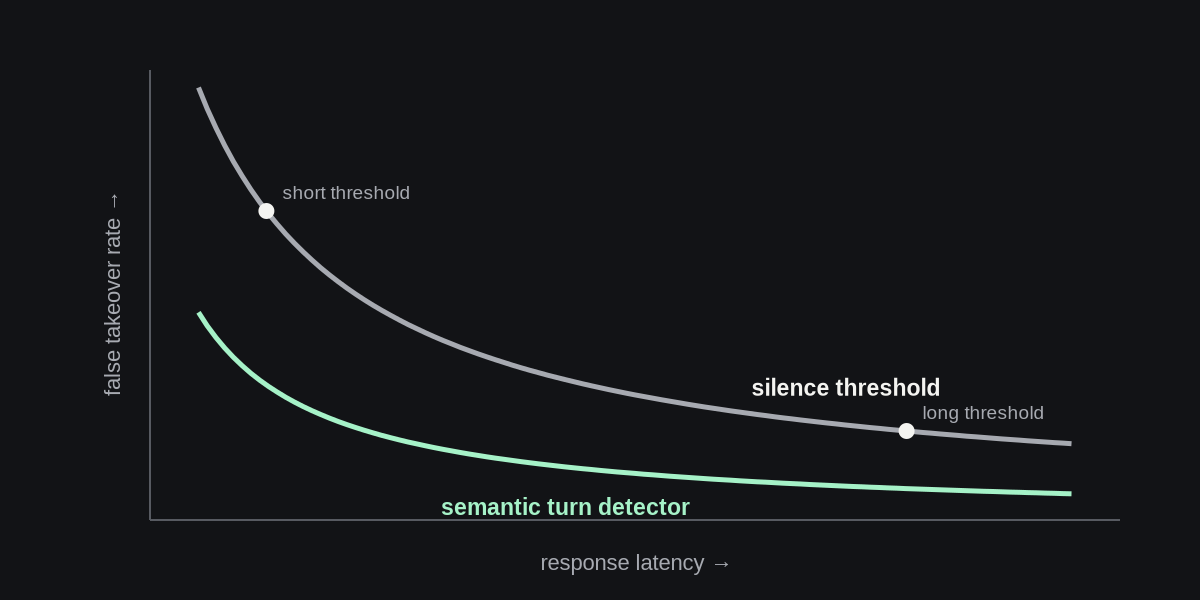
One agent may be faster than another only because it accepts more false takeovers. Report the response gap and the false takeover rate together, at the setting you will deploy, and where you can, plot the curve.
Semantic turn detectors look at the turn so far and predict whether it is complete. LiveKit's earlier detector read the transcript; its current one listens to the audio for both meaning and intonation [8]. Pipecat's Smart Turn works on the audio directly [9]. "My account number is" followed by silence is clearly unfinished; "that's all, thanks" is clearly finished. In LiveKit and Pipecat, a short stretch of silence found by voice activity detection triggers the detector, which then either ends the turn or extends the wait. The detector adds its own inference time to every turn end, so it has to be small and fast. Full-duplex models make the decision at every audio frame as they listen [10].
Measure what the caller hears
Most teams measure latency from server logs: the time the end-of-speech event fired, the time the first audio packet left. The end-of-speech event is the voice activity detector's guess that speech stopped, which is not the same as the turn end. Those timestamps miss parts of the delay the caller hears.
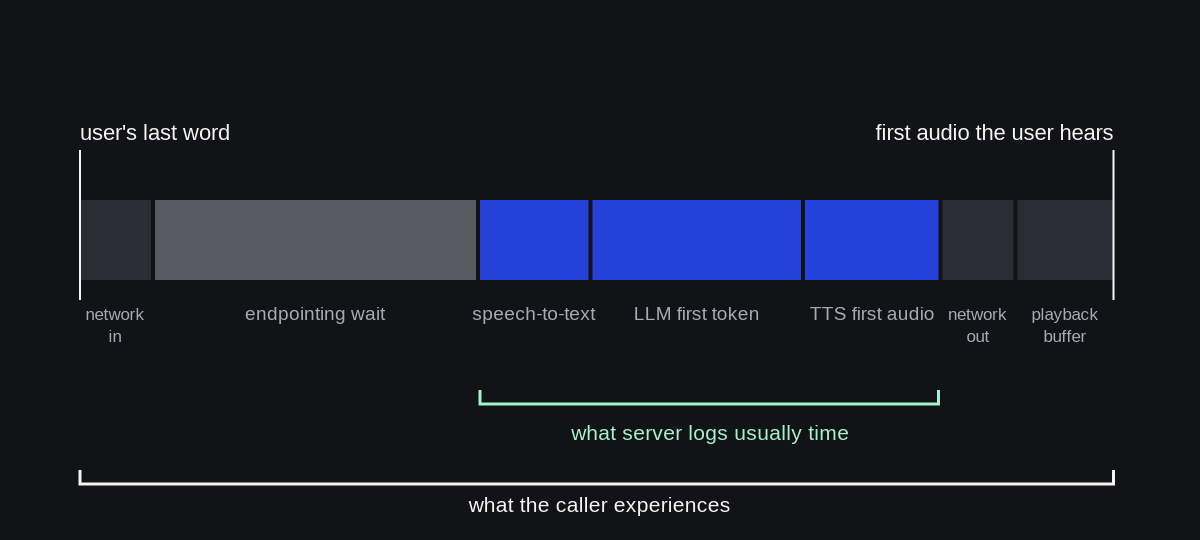
The endpointing wait is the clearest example. An agent that waits 700 ms of silence before deciding the user has finished has spent 700 ms before any model runs, and a server log that starts its clock at the end-of-speech event will not show it.
We record the conversation at the user's end, with the user's audio on one channel and the agent's on the other, as a phone or browser would play them. In practice that means a test client on the same path real users take, a WebRTC client for a browser agent or a SIP endpoint for a phone line, writing both directions to one stereo file. Then every event is derived from the recording:
- Run voice activity detection separately on each channel to find who is speaking when.
- Use word timestamps from an STT model to separate speech from noise, and to place the end of the last word.
- Match each planted event (a pause, a backchannel, a barge-in) to what the agent did around it.
Four details decide whether the numbers can be trusted:
- One clock. Both channels must be captured by the same process, or aligned with a known sync tone at the start. A few tens of milliseconds of drift is the size of the effects being measured.
- Echo. On a real phone line some of the agent's audio leaks back into the user's channel. If the user channel is analysed raw, the agent's own speech looks like a barge-in.
- The detector's own delays. Every voice activity detector needs some speech before it fires and some silence before it lets go. Those settings shift every measured start and stop, so fix them once and use the same values for every system.
- When audio has stopped. Some agents fade out rather than cut. Define stop as the channel's energy staying below a set level for a set time, and use the same definition for every system.
This makes numbers comparable across systems, because it ignores how each vendor defines its own events. It also catches bugs that logs hide: a jitter buffer adding delay, audio that is generated but never played, an agent that stops generating but keeps playing what it had already sent.
Build the test set from real speech
The user side of the test is the hard part. Synthetic users made with text-to-speech are fluent and evenly paced, so they rarely pause mid-sentence the way people do. An agent tuned on them will look better than it is.
Use recordings of real people where you can. A recording cannot react, so the events have to be scheduled. Mid-turn pauses are recorded or edited into the user's audio in advance. Backchannels and barge-ins have to be timed against the agent's speech as it happens: the test client starts playing them a set time after the agent starts talking, so they land in the middle of its turn whatever its latency. The cases worth including:
- Pauses inside turns: reading out numbers, spelling a name, "my order was… let me find it… 4471".
- Self-corrections: "Tuesday, no, Wednesday", among the most consistent failures for every system in Full-Duplex-Bench-v3 [7].
- Backchannels at different points in the agent's speech.
- Barge-ins that correct, that redirect and that just say "stop".
- Noise: coughs, a second voice, music, a phone line's compression.
- Accents and languages your users speak. Turn-taking rhythm varies between languages [1], so test the end-of-turn detector in each one you deploy.
A voice agent's responses vary, so run each case several times and report the median and the spread across runs (how many runs).
What this means for DuplexTurn
DuplexTurn scores these events. Each case is played to the agent as recorded speech with scheduled pauses, backchannels, barge-ins and noise, both sides are recorded at the user's end, and every metric above is computed from that recording. We report the response gap and the false takeover rate together, alongside tool calls made mid-turn and whether the agent stays quiet when it should, and we run cascades, half-cascades and native models through the same cases.
References
- T. Stivers et al. Universals and cultural variation in turn-taking in conversation. PNAS 106(26), 2009. DOI
- S. C. Levinson, F. Torreira. Timing in turn-taking and its implications for processing models of language. Frontiers in Psychology 6, 2015. DOI
- M. Heldner, J. Edlund. Pauses, gaps and overlaps in conversations. Journal of Phonetics 38(4), 2010. DOI
- G.-T. Lin et al. Full-Duplex-Bench: A Benchmark to Evaluate Full-duplex Spoken Dialogue Models on Turn-taking Capabilities. IEEE ASRU, 2025. arXiv
- G.-T. Lin et al. Full-Duplex-Bench v1.5: Evaluating Overlap Handling for Full-Duplex Speech Models. 2025. arXiv
- G.-T. Lin et al. Full-Duplex-Bench-v2: A Multi-Turn Evaluation Framework for Duplex Dialogue Systems with an Automated Examiner. ACL, 2026. arXiv
- G.-T. Lin, C. Chen, Z. Chen, H. Lee. Full-Duplex-Bench-v3: Benchmarking Tool Use for Full-Duplex Voice Agents Under Real-World Disfluency. 2026. arXiv
- "Solving end-of-turn detection: LiveKit Turn Detector v1.0." LiveKit.
- "Smart Turn: an open source, native audio turn detection model." GitHub.
- A. Défossez et al. Moshi: a speech-text foundation model for real-time dialogue. Kyutai, 2024. arXiv