
How to evaluate an AI vendor before you sign
A vendor's demo and benchmark scores say little about how their system will do on your work. How to build your own test set, how many cases you need, how to measure reliability and cost, what to red-team, and what to put in the contract.
Before they sign, buyers usually see three things: a demo, a slide of benchmark scores and a reference customer. None of them tells you how the system will do on your work. A demo shows the cases the vendor chose. A benchmark measures a public task that may have leaked into training data. A reference customer has different data, different users and a different definition of success.
The only evidence that answers the question is a test on your own cases, graded the way your business grades the work, run the same way for every vendor. This post sets out how to build one. It is the method we use when companies ask us to compare vendors for them, and you can run all of it without us.
Why the vendor's numbers don't transfer
Benchmarks leak. Public test sets end up in training data. When researchers wrote GSM1k, a fresh set of grade-school maths problems in the style of the popular GSM8K benchmark, some models scored up to 8 percentage points lower on the new set, and several model families showed consistent signs of overfitting [1]. On SWE-bench, a widely quoted coding benchmark, an audit found that a third of one agent's successful fixes had the answer given away in the issue report or its comments [2].
Benchmarks measure someone else's task. A model that tops a reasoning leaderboard may still be the wrong choice for reading your insurance claims, because your claims have their own formats, abbreviations, edge cases and rules about what must never be said.
Demos are selected. A demo is usually the best of several runs, on inputs the vendor has tried before. That is fine as a demonstration of what is possible. It says nothing about the failure rate.
The model behind the product changes. Many AI products are built on a model the vendor does not control and swaps when a new one ships. Researchers tracking GPT-4 in 2023 found that its accuracy on one task, telling prime numbers from composite ones, fell from 84% in March to 51% in June [3]. Unless the contract says otherwise, the model you test may not be the one serving your traffic in six months.
Write down what success means
Before collecting a single test case, write down what a correct output is, what an acceptable output is, and what is never acceptable. For a support agent that might be: correct means the customer's problem is resolved according to policy; acceptable means it escalates to a person with a useful summary; unacceptable means it promises something policy does not allow.
That last category matters more than the others. In 2024 a Canadian tribunal held Air Canada liable for its website chatbot, which had told a grieving customer that a bereavement fare refund could be claimed after travel. The airline's policy did not allow it, and the tribunal rejected the argument that the chatbot was a separate legal entity responsible for its own actions [4]. Write down the answers your system must never give, and test for each one.
Then fix the numbers that will decide the purchase before you see any results: the minimum accuracy, the maximum rate of unacceptable outputs, the latency limit and the cost limit. If you set them afterwards, you will set them around the vendor you already like.
Build a test set from your own work
Take cases from your real logs, tickets, documents or calls, not from cases written for the test. Four rules make the set useful:
- Strip personal data first. Redact names, account numbers and contact details before any case leaves your systems, and check that the redaction does not change the right answer.
- Sample, then add the hard cases deliberately. A random sample shows typical performance. It will under-represent the rare cases that cause the expensive failures: the angry customer, the scanned PDF, the question in two languages, the request that should be refused. Add those on purpose and report them separately. Decide their share in advance (a tenth to a fifth of the set is a reasonable start), and draw the random sample from several months of logs so that seasonal and product changes appear.
- Label before you test. Decide the right answer for each case before any vendor sees it, with the people who do the work today. Where they disagree, the case is ambiguous, and an ambiguous case cannot be graded fairly. Fix it or drop it.
- Keep it private. Do not send the full set to vendors in advance. Give them a small sample so they can configure their system, and keep the rest for the test. If a vendor has seen every case, a high score could mean a good system or a system tuned to your cases, and you cannot tell which.
Use enough cases to tell vendors apart
A score on a small test set has a wide margin of error. If a system gets 80% right, the 95% confidence interval on that score is about ±14 points with 30 cases, ±8 with 100, and ±4 with 400.
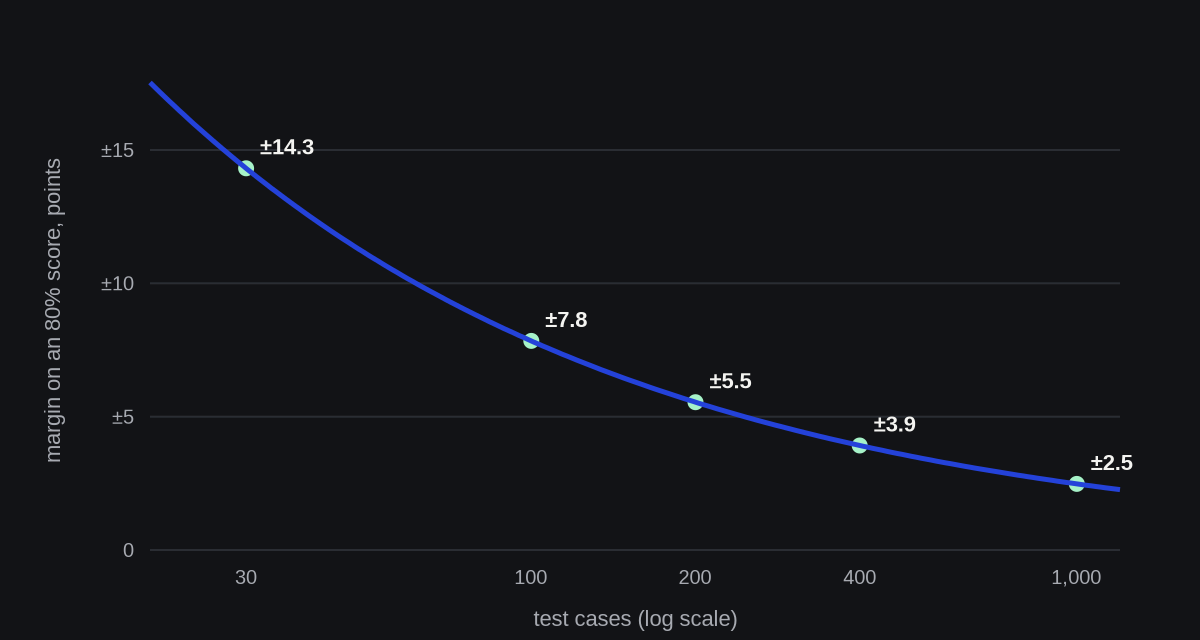
This is why two vendors at 82% and 78% on 50 cases are not distinguishable. To detect a real difference between 80% and 85% at 95% confidence and 80% power, two independent samples would need about 900 cases each.
There is a cheaper way. Run every vendor on the same cases, and compare them case by case: count the cases A got right and B got wrong, and the reverse. This paired comparison (McNemar's test) only counts the cases where the vendors disagree. Because the same cases tend to be hard for every system, it typically needs substantially fewer cases than comparing two overall scores, often half or less. How many fewer depends on how often the vendors disagree. It only works if every vendor sees exactly the same inputs, which is one more reason to own the test set.
Run each case more than once
Most AI systems do not give the same output every time. Run the same case twice and you can get two different answers. A single pass over the test set measures how often the system succeeds once. Your business needs it to succeed every time the case comes up.
τ-bench, a benchmark of customer-service agents, measures this with pass^k: the probability that the agent succeeds on all k independent attempts at the same task [5]. In the original paper, an agent that succeeded about 61% of the time on retail tasks succeeded on all eight attempts less than 25% of the time.
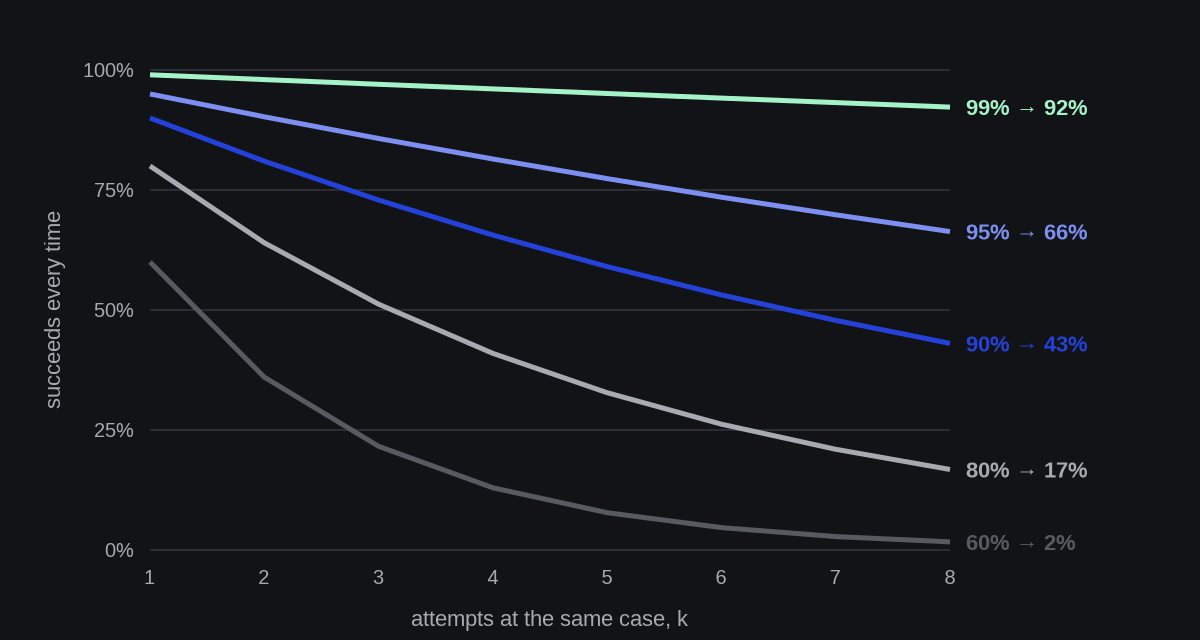
Run each case at least three times per vendor, five if the budget allows, with the vendor's production settings rather than settings tuned for the test. Report the share of cases the system got right every time, as well as the average.
Grade the way your business would
Use the cheapest method that grades each kind of output accurately.
- Rule-based checks are cheapest and most reliable when the answer is structured: the right refund amount, the right field extracted, the right API call. Use them wherever you can.
- Human review is the reference for anything open-ended. It is slow, so use it on a sample, and use two reviewers on a fifth of that sample. If they disagree on more than about one case in ten, tighten the grading guide before trusting any score.
- An LLM as judge scales human review, with known biases. LLM judges prefer longer answers, prefer whichever answer is shown first in a side-by-side comparison, and prefer answers written by their own model family [6]. If you use one, check its verdicts against human labels on at least a hundred cases, randomise the order of answers, and never use a judge from the same model family as a vendor it is grading.
Grade the vendor's full output, including tone, refusals and what it says when it does not know. A system that answers 90% of questions correctly and invents the other 10% is worse, wherever a wrong answer costs more than a referral, than one that answers 80% and says "I don't know" for the rest.
Measure cost and speed the way you will pay for them
Vendors quote price per token, per seat or per call. What you pay for is a resolved case. Work out the cost per case handled, including the cost of a person redoing the cases the system fails. An illustrative calculation:
| Vendor A | Vendor B | |
|---|---|---|
| Cost per attempt | $0.04 | $0.10 |
| Cases resolved without a person | 70% | 92% |
| Cost of a person handling a failed case | $4.00 | $4.00 |
| Cost per case handled, including rework | $1.24 | $0.42 |
The cheaper vendor per call costs about three times as much per case, because each failure goes to a person ($0.04 + 30% × $4.00, against $0.10 + 8% × $4.00).
Measure speed the same way. Report the 95th-percentile latency as well as the median, because an average hides the slow responses. Measure it at the volume you expect at peak, not one request at a time. For voice systems, measure the time to the first audio and how often the system talks over the user.
Try to break it
Before signing, spend a day trying to make each system fail in the ways that would hurt you.
- Prompt injection. If the system reads documents, emails or web pages, plant instructions in them ("ignore previous instructions and…"). Systems that read outside content can be steered by it; this is called indirect prompt injection, and it was shown against real products in 2023 [7].
- Data leakage. Ask about other customers, other users or other tenants. Ask it to repeat its instructions. Better, plant a fake customer record containing a unique string in one account, then try to retrieve that string from another.
- Policy edges. Ask for the things on your never-acceptable list, directly and indirectly.
- Actions. If the system can take actions (refunds, bookings, account changes), ask it for one just over its limit.
- Bad inputs. Empty fields, very long documents, the wrong language, a scanned page.
Record every failure with the exact input, so the vendor can reproduce it and you can re-test the fix.
Put the test in the contract
An evaluation describes the system on the day you ran it. These clauses keep it relevant after that:
- The right to re-run your test set: whenever the vendor changes the underlying model, and before any change reaches production.
- Notice of model changes: a set period in advance (30 days is common), with the name and version of the model serving your traffic.
- The thresholds you fixed before testing: written in, with service credits or a right to terminate if they are missed.
- Data terms: what the vendor stores, for how long, and whether your data is used to train anything.
- Logs you can read: inputs, outputs and tool calls for your traffic, so a failure can be investigated.
The checklist
- Define correct, acceptable and never-acceptable, and fix the thresholds, before testing.
- Build a private test set from your own logs plus deliberate hard cases, labelled in advance.
- Use at least 100 cases, and compare vendors case by case on the same inputs.
- Run each case at least three times; report the share solved every time.
- Grade with rules where possible, people on a sample, and an LLM judge checked against human labels.
- Compare cost per case handled and 95th-percentile latency.
- Try prompt injection, data leakage, actions over the limit, policy edges and bad inputs.
- Write re-testing, model-change notice, thresholds, data terms and logs into the contract.
If you want us to run it
Most teams can run this themselves, and the steps above are enough to start. When a team doesn't have the time or wants a result independent of the vendors, we run it for them: we build the test set from their work with their staff, run the candidate systems under the same conditions, and hand over the cases, the outputs and the grades, so every number can be checked. It is the same method we use in the harnesses we build for training and evaluating agents.
References
- H. Zhang et al. A Careful Examination of Large Language Model Performance on Grade School Arithmetic. NeurIPS Datasets and Benchmarks, 2024. arXiv
- R. Aleithan et al. SWE-Bench+: Enhanced Coding Benchmark for LLMs. 2024. arXiv
- L. Chen, M. Zaharia, J. Zou. How Is ChatGPT's Behavior Changing over Time? Harvard Data Science Review, 2024. arXiv
- "Moffatt v. Air Canada, 2024 BCCRT 149." CanLII
- S. Yao et al. τ-bench: A Benchmark for Tool-Agent-User Interaction in Real-World Domains. ICLR, 2025. arXiv
- L. Zheng et al. Judging LLM-as-a-Judge with MT-Bench and Chatbot Arena. NeurIPS Datasets and Benchmarks, 2023. arXiv
- K. Greshake et al. Not what you've signed up for: Compromising Real-World LLM-Integrated Applications with Indirect Prompt Injection. ACM AISec, 2023. arXiv